28
Oct 11

The different types of ocarinas

Do you know what ocarinas are? If you have some sort of a connection with the field of music, there is every chance that you have heard about ocarinas. It is a musical instrument that is based on wind. It has a lot of resemblance with the flute in the way it is used to produce music. There is quiet some differences between the type of music produced and the shape in the case of ocarinas and a flute. The ocarinas have a bit of history behind it. You will be able to find this musical instrument in the ancient history itself. There are different varieties of ocarinas available today. The basic structure is that of a main body with some holes and the mouthpiece that stays projected from the main body of the instrument. The number of holes in the body could vary according to the type you want to have. The main material used to make the ocarinas is ceramic. You will also find some versions made of different materials than the ceramic such as clay, glass, wood, and metal.

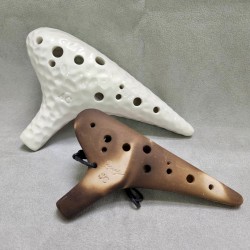
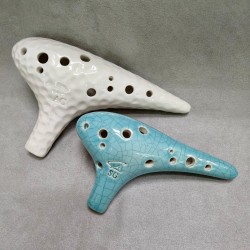
There are a vide range of different ocarinas available to you at present. The difference could be based on the number of holes, number of chambers, and even the material used to make it. There are some version that has keys and even slides. This helps the user to increase the range of notes according to the situation and personal wish. The most common varieties are as follows:

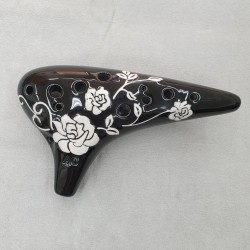
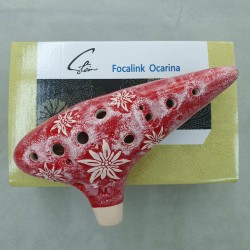
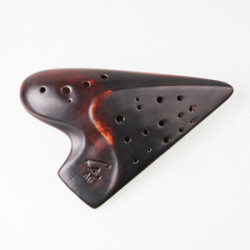
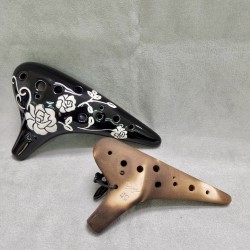
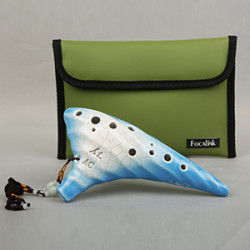
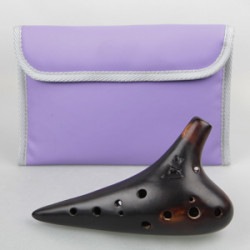
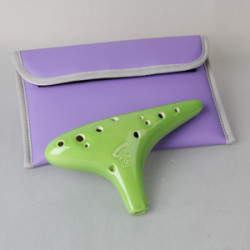
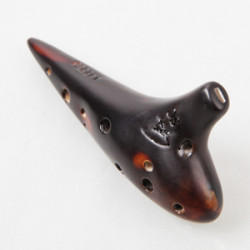
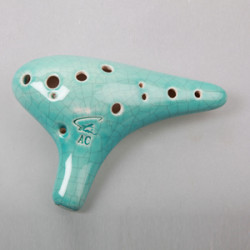
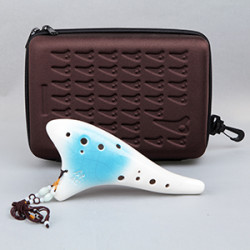
  • Transverse – This is one among the more common versions that you can find among the ocarinas. It is also called as sweet potato. It has more of a round shape. It should be held with two hands in a horizontal position. The holes in the ocarina is closed and opened accordingly while blowing in to the mouthpiece to produce the desired music. There are mainly two versions of transverse ocarinas available and the difference is based on the number of holes in it. They are the ones with 10 and 12 holes.

  • Pendants – The pendant version is another common type of ocarina that you can find. There are mainly two different types of pendant ocarinas. They are the English pendant and the Peruvian pendant. The English version has only about 4 – 6 holes and is very portable. The Peruvian pendant has about 8 or 9 holes and they comes in different shapes. You will be able to find the Peruvian pendant having the shape of animals or some normal shapes like oval. It is commonly seen as an instrument used in ceremonies, rituals, and in some celebrations.

  • Inline – This is another version of the ocarinas and it is believed to be a fusion of both the transverse and the pendant versions. It is one among the more compact ocarinas in the group. One of the striking features of this version is that it has more holes as compared to the pendant ocarina. This makes the person using it to ascend the pitch of the music with the help of a linear pattern of the fingers.

  • Multi chambered ocarinas – these are the versions of ocarinas, which have more than one chamber. The main types available are the double and the triple chambered ocarinas. The main feature of this version is that, they have helped to overcome the problem of having a very less number of notes.


25
Oct 11

Ocarina, The Simple Fun Instrument

The ocarina is known as one of the easiest of all wind instruments to play, there are no complicated breathing patterns and the notes are simple to learn and easy to finger. Getting a good clean tone from the ocarina is as simple as blowing a whistle however there are some points beginners should take into account when learning the instrument in order to maximize their time spent and the return on investment:

  • Get a fingering chart and consult it regularly, the more time you spend learning the finger positions the easier they are to remember and play.
  • Find some complete songs and start at the beginning, learn the song in parts until you can play the whole piece together. The satisfaction from learning a whole song will be enormous and the confidence boost it gives you unmatched.
  • Learn the musical scales. Learning scaled helps you with all types of music not just ocarina playing and it also helps you to improvise while jamming.
  • Get your rhythm absolutely solid, rhythm is one of the most under valued pieces of ocarina playing and it will make your tunes sound 10 x better.
  • Learn musical notation, not only will this allow you to play any song you want but it will also help you enormously if you move onto a more advanced instrument.
  • When starting out start with simple songs such as folk and marches, remember the motto you must learn to walk before you run.
  • Get motivated by practicing with other or watching videos of talented musicians playing amazing pieces on their ocarina.
  • Don’t just have a set time to practice, bring your ocarina with you and play while sitting on the bus or in your local park.
  • Learn the scales/songs but don’t be afraid to experiment and sometimes just throw caution to the wind and just play what sounds good.

Remember like any instrument the ocarina takes time, skill and dedication to master. Try to keep it fun and productive and you will be belting out amazing tunes in no time.


06
Sep 11

The Many Uses of the Zelda Ocarina

When people think of the Legend of Zelda, a few things immediately come to mind. Among those things are the beautiful princess, the brave Link, the magnificent swords and shields, and last, but certainly not least, the legendary Zelda ocarina. The ocarina found in the Zelda games appears much like an ocarina that you or I might own, but its function is drastically different. While we can use our ocarinas to play beautiful music, that’s about the full extent of its uses. The Legend of Zelda ocarina, however, can do much more. While you can improvise your own songs in the game, there are many specific songs that when played, a number of seemingly magical events take place.

The ocarina is full of features, as the player can modify the pitch of notes, use vibrato, and even scales can be played.

The Zelda ocarina is found is The Legend of Zelda – “Ocarina of Time”, and “Majora’s Mask”. Link is given the ocarina by Princess Zelda when he is still a child, and it is first put to use by Link who plays the Song of Time, allowing Link to open the Door of Time. After playing this, the character wakes up, but Link is now an Adult.

Link can play thirteen different songs in Ocarina of Time, all of which have distinct uses. A favorite amongst many Zelda fans is “Epona’s Song”. Epona’s song summons Link’s horse, Epona, who allows link to travel around much faster, access areas that he wouldn’t be able to reach without her, and even fight enemies while riding her. For example, when Link visits Gerudo Valley as an adult, the bridge is no longer there, so he cannot simply walk across the valley gap anymore. Due to Epona’s power, Link can jump over the gap while riding her. While this area can be accessed by using a tool known as the longshot, many prefer to summon Epona using the Zelda ocarina.

Another commonly use of the ocarina is the playing of the Sun’s Song. When the Sun’s song is played the game changes from day to night, or night to day. There are many specific times where this will be needed, but the ocarina can be used to play this song for mere aesthetic purposes. If one finds the night time to be rather spooky, the Sun’s Song can be played and the player will be in daylight once again. There are some instances where this cannot be done. For example, some areas of the game cannot be accessed at night time, so if this song is played, Link will be transporter to the outside of the area until the area can be accessed again. There are also ghosts that appear in Hyrule Field at night time, so if the player is looking to battle or capture ghosts, the Zelda ocarina can be used to facilitate this.

Two of the aforementioned songs allow Link to travel through time, but those aren’t the only uses of the Zelda ocarina. It can also be used to warp link to different locations throughout the game. These songs take Link to a number of different locations, some of which are Temples. For example, the Prelude of Light brings the character to the Temple of Time.

A unique use of the ocarina is playing the Scarecrow’s song. When Link is young, he meets a scarecrow, and the scarecrow invites Link to create his own song. After the player creates his or her own song, the scarecrow will memorize it. As Link returns to Lake Hylia as an adult, the same scarecrow is still there. If the player has remembered the unique song that they created, and can play it back to the scarecrow, the scarecrow will be delighted, and informs the player of another scarecrow who can help Link reach locations that are not accessible without his services.

Another song that does not deal with time travel or location warping is Saria’s Song. Saria is a childhood friend of Link’s, and she teaches him her song. It allows Link to use the ocarina to contact her throughout the game, and aside from providing moral support, she offers useful tips that may not otherwise be obvious to the player. This can help the player reach their objective, as the game can be confusing for some people at times.

Without this legendary instrument, the Legend of Zelda games would be nothing like we know them. It is one of the many things that made the Zelda games so unique, and so multifarious.


05
Sep 11

Don’t Have a Real Ocarina? Ocarina Software is the Next Best Thing!

While everyone would love to have an ocarina, you might not want to spend the money on one, especially if you’ve never played an instrument before, or if you just learned about ocarinas. It is by no means the same as the real thing, but ocarina software is becoming more and more advanced, and it is extremely affordable! Available for a wide variety of platforms (PC, Mac, iPhone, iPad, Android, and more!), ocarina software varies from extremely basic for the beginner, to advanced for the seasoned ocarina player. We’ll discuss some of the top pieces of ocarina software, and go over what makes them good, or bad.

ocarina software for iphoneThe first, and by far the most impressive ocarina software we have seen so far, is “Ocarina” made by Smule. Ocarina by Smule is available for the iPhone and iPad, and we are blown away by it. Ocarina finds itself in Apple’s All-Time Top 20 apps, and once you’ve used it, you’ll know why. Aside from the shape, there’s hardly any difference between this app and the real deal. It works by blowing into the built-in iPhone or iPad microphone, and then pressing the circles (holes) on the screen. More than one circle can be touched at the same time, allowing you to play different notes. If that’s not enough for you, the app uses the built in accelerometer to allow you to modify the vibrato rate, and you can even change the key of the ocarina, or, if you’re a fan of the Legend of Zelda games, give the Zeldarian mode a shot. Once you’ve played your masterpiece, there are a number of features that allow you to interact with others, and take part in the ocarina community. There are features that allow you to gain inspiration from other people by listening to their performances, and you can even let them listen to you! For only 99 cents, this app is a no brainer, and it is our favorite by far.

If you don’t have an iPhone or iPad, or you just don’t want to use ocarina software on it, there is software available for other platforms. The app “Ocarina Flute” by Caio Bulgarelli is available for purchase on the Android platform for $1.59, although it has been on sale for only 99 cents in the past. It requires Android 2.2 or higher, and Adobe AIR. This ocarina software is not nearly as refined as Ocarina by Smule, but for less than the price of a coffee, it’s not a terrible deal by any means. The interface is not nearly as aesthetically pleasing as Ocarina is, but one thing that this ocarina software has going for it is the realism of the sounds. The sounds are nearly as close to a real ocarina as you can get, so what it lacks in interface, it makes up for with the sounds. With a pair of headphones, or hooked up to a set of speakers, Ocarina Flute can fool nearly anyone into thinking it is the real deal.

If you don’t have $1.59 to spare, or perhaps you don’t have an account to purchase apps from the Android Market Place, the app “Ocarina” by Ben Kay is a free alternative for the Android platform (version 2.1 or higher). Unfortunately, this app does not feature the same realistic sounds as other Android apps, but the interface is comparable. It allows the selection of keys, and has many of the same features as Ocarina Flute, but the sounds are not comparable. While we give the developer credit for making this ocarina software free and available to everyone, it can do with some refinement with the sounds. If this is addressed in a future update, then Ocarina by Ben Kay could be an ocarina software alternative.

While the ocarina software we have discussed is exclusively for handheld devices (iPhone, iPad, and Android compatible devices), there are other software choices available out there. These other pieces of software are frequently more powerful than the handheld versions, but they lack the hands on feeling that the mobile devices provide. Aside from the iPad or Android tablets, most iPhones or Android phones are a similar size and shape to that of a real ocarina, and we feel that this greatly adds to the genuine experience. There’s no doubt that a true ocarina has a completely different feeling in your hands, but the iPhone and Android phones do a fairly good job of replicating this feeling.


22
Jul 10

Very funny video of Link in ocarina of time.

Sorry we haven’t updated here in quite a while. Don’t worry we are gearing up for a relaunch. Expect big things soon.


07
Jun 10

4 Reasons to Learn The Ocarina

  1. 1. The ocarina is an affordable instrument to buy – ocarina prices start from as low as $10.
  2. 2. Ease of use – Ocarinas vary in complexity (from 4 holed ocarinas to 12 holed). Over blowing is not possible due to the vessel shape (unlike flutes or recorders) and therefore the usually very notable sounds of squeaking apprenticeship do not hound students. This gives beginners a quick sense of mastery over their instrument. Teachers acknowledge that this can send a student’s sense of pride and achievement soaring.
    There are a range of instructional methods accessible to budding ocarina students making their pursuit to accomplish playing even more complicated melodies possible. Some of these include: video tutorials of ocarina skills, fingering charts, free computer programs, social musical communities for sharing advice on-line. Students can also compete in international ocarina competitions such as the STL Ocarina International Star Search Competition (http://blog.stlocarina.com/stlcompetition/how-to-enter-guide.html)
  3. 3. Compact – due to the fact that tone is not determined by the length of the pipe, as it is with other flute-like instruments, but instead by the size of the holes. Even though most are small enough to fit in your pocket, some also come with a neck cord for extra carrying convenience.
  4. 4. A rich culture and history – Having spanned across continents over a period of 12,000 years means tracing the ocarina’s path to modernity encompasses a broad educational spectrum. Some highlights ideal for teaching in class include:
    • Use of the instrument by the ancient Incan, Aztec, Mayan and Chinese civilizations
    • Court musicians played their ocarinas for the Roman Emperor 16th century Europe
    • An Italian baker was responsible for increased popularity in Western culture by cooking the perfect ocarina in the 1800s
    • Soldiers played tunes to each other between combat during both of the 2 great world wars to lift their spirits

27
May 10

How An Ocarina Produces A Tone

How an ocarina works.

Tone production/acoustics

  1. Air enters through the windway.
  2. Air strikes the labium, producing sound.
  3. Air vibrates throughout the inside of the ocarina.
  4. Covering and uncovering holes lowers and raises the pitch.

The ocarina, unlike other vessel flutes, has the unusual quality of not relying on the pipe length to produce a particular tone. Instead the tone is dependent on the ratio of the total surface area of opened holes to the total cubic volume enclosed by the instrument. This means that, unlike a flute or recorder, sound is created by resonance of the entire cavity and the placement of the holes on an ocarina is largely irrelevant — their size is the most important factor. Instruments that have toneholes close to the voicing/embouchure should be avoided, however, because this weakens tonal production since an ocarina is a Helmholtz resonator.

The resonator in the ocarina can create overtones, but because of the common “egg” shape, these overtones are many octaves above the keynote scale.[8] In similar Helmholtz resonator instruments with a narrow cone shape, like the Gemshorn or Tonette, some partial overtones are available. The technique of overblowing to get a range of higher pitched notes is not possible with the ocarina because of its vessel shape, so the range of pitches available is limited to a 12th. Some Ocarina makers increase the range by designing double- or triple-chambered ocarinas tuned 1 octave apart although some double ocarinas are not made to increase the range, but to play in harmony with the other chambers. The double and triple ocarinas can also play chords.

Different notes are produced by covering the holes, and by opening and closing more or less of the total hole area. The tone is then produced through the sound hole/embouchure. The tone can also be varied by changing blowing strength to bend pitch.


26
May 10

The Various Types Of Ocarinas

Ocarinas vary in shape and number of holes. The various types of Ocarinas are listed below:

pendant ocarinaPendant – These are generally quite small and therefore very portable. Two different variants exist: The more common of the two is the “English” pendant, aptly named for using England’s particular fingering system (4 – 6 holes). The “Peruvian” pendant instead uses 8-10 holes (Peru’s equivalent).

sweet potatoe ocarinaTransverse (shaped like a sweet potato) – This is the most widely known ocarina type. It is round in shape and grasped with 2 hands horizontally. To escalate the pitch, open 1 more hole than the previous in line. The 10 – hole (originated in Italy by Giuseppe Donati) and the 12 – hole are the most popular Transverse ocarinas.

inline ocarinaInline – otherwise known as a “fusion” between the Pendant & the Transverse ocarina. Inlines are miniature and compact, even though their holes are more numerous than that of the pendant. Thus this allows the user to escalate the pitch using a linear finger pattern instead of finger combinations.

In the late 19th century, several makers produced experimental ocarinas with keys. Adding slides and keys has the effect of either: enabling users’ fingers to reach holes that are broadly spaced or, increasing the instrument’s musical range.

multi chambered ocarina, multi octave ocarinaMultiple chambered ocarinas – otherwise known as “Triple” & “Double” ocarinas. Multiple chambers allow for a broader range of notes (a drawback to single chambered ocarinas). Transverse triples play with a range of about two octaves and seven notes. Transverse Double ocarinas typically play with a range of two octaves and two notes. Double ocarinas for Pendant and inline ocarinas also exist. Specially designed double inline ocarinas have the ability to play chords, thus allowing for harmonies.


24
May 10

A Good Example Of Advanced Ocarina Play

Here is a very talented individual playing a lovely ocarina song. If your sitting on the fence and thinking of buying an ocarina this should be motivation enough. We at buy ocarina . com recommend purchasing through STL Ocarina as they have a wide range of quality instruments available at some of the best prices. Click here to visit them now.


22
May 10

How To Play Your New Ocarina

Purchase an ocarina suitable to your skill level. Be sure to buy your ocarina from a specialist to guarantee its function is for playing music and not just for show as a fancy non practical ornament. Diatonic or Chromatic ocarinas are more suited for beginners. Plastic variants of both types are cheap and widely available. Aspiring professionals should choose chromatic.

Accompanying handbooks will give instructions for fingering to produce different notes. The labelling of holes on a diatonic instrument for beginners is as follows: 1, right top 2, left bottom 3, right bottom 4, open hole is indicated by ‘X’.
Note instructions:

A – x, x, 3, x.
Bb (A sharp) – x, x, x, 4.
C – x, x, x, x, with all fingers removed from all holes
Natural C – 1, 2, 3, 4 (the lowest note a diatonic ocarina can play). Position middle left finger on the left top hole, your index left finger on left bottom hole, your middle right finger on right top hole and your index right finger on the right bottom.

D – 1, x, 3, 4. It is played in the same way as C, but without your right middle finger on the top right hole.
E – 1, 2, 3, x.
F – 1, x, 3, x.
F sharp (Gb) – x, 2, 3, 4.
G – x, x, 3, 4.
G sharp (Ab) – x, 2, 3, x

Chromatic ocarinas for beginners – same note playing method, however left thumb must be put over the back left hole, & your right thumb covering the right back hole.

A basic learning exercise to practice is to do a scale of C : C – D – E – F – G – A – B – C. Try it both ascending and descending. Importantly, enjoy learning how to play your ocarina :)